Storage engines, indexes, transactions, and the systems underneath modern data infrastructure
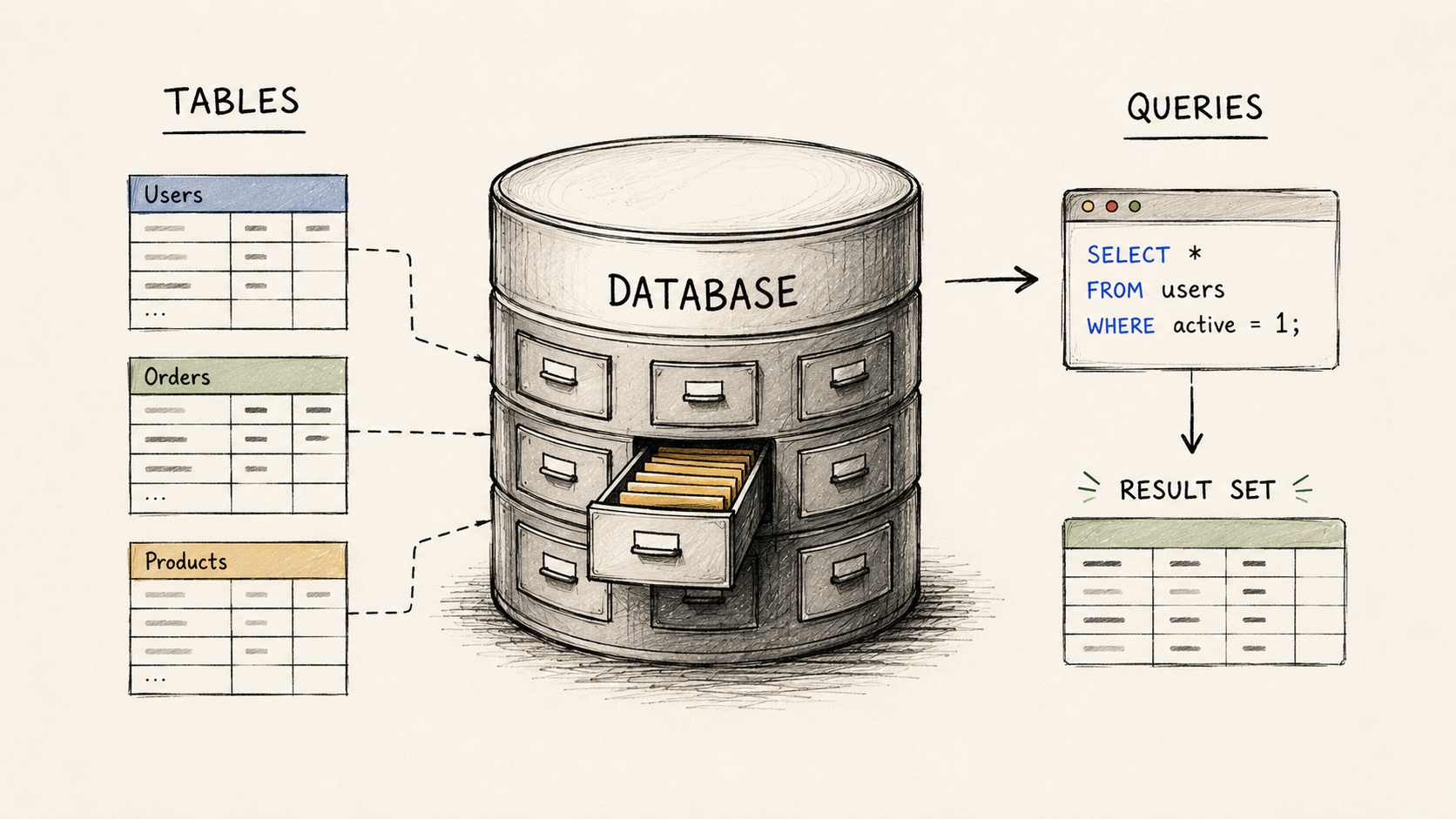
Modern software depends on databases so heavily that most applications stop feeling like software and start feeling like persistent environments. Messages remain after refreshing a page, user accounts exist across devices, orders remain stored for years, recommendations adapt dynamically, and search systems retrieve information from datasets containing billions of records within milliseconds. From the user’s perspective, the data simply “exists.”
But databases are not passive storage containers sitting underneath applications.
They are highly optimized coordination systems designed to organize, retrieve, cache, synchronize, protect, and recover information efficiently while many operations happen simultaneously across hardware constrained by memory limits, storage latency, concurrency conflicts, and network delays. Large systems may process millions of reads and writes continuously while coordinating transactions, maintaining indexes, replicating state across infrastructure, recovering from failures, and attempting to keep queries fast enough that applications still feel responsive.
The complexity exists because storing information is relatively easy. Retrieving and coordinating information efficiently at scale is not.
As datasets grow larger, searching through all stored data repeatedly becomes too expensive. As applications gain more users, many systems begin attempting to read and modify the same information concurrently. As infrastructure scales across multiple machines and regions, consistency and synchronization become increasingly difficult. And because storage systems are slower than memory while memory itself is limited, databases must constantly balance tradeoffs involving caching, indexing, disk access, concurrency, and fault tolerance.
Modern database architecture evolved largely around those constraints.
In this article, we’ll examine how databases actually work underneath the surface, why indexing became essential, how query execution works, how transactions maintain consistency, why concurrency creates difficult coordination problems, and why distributed databases became one of the hardest areas in modern systems engineering.
Why Applications Needed Databases Instead of Plain Files
At very small scale, applications can store information directly in ordinary files. A simple program may write JSON documents, text files, CSV data, or binary data structures to disk and reload them later when needed.
This approach works surprisingly well initially.
The problem appears once systems begin growing beyond small datasets or single-user workflows. Applications eventually need to retrieve information quickly, coordinate many simultaneous users safely, prevent corruption during crashes, update records continuously, maintain relationships between data, and search increasingly large datasets efficiently. Once those requirements emerge, simple file storage starts becoming difficult to manage reliably.
Imagine a large application storing millions of user records inside one giant file. Retrieving one specific record might require scanning enormous portions of the dataset repeatedly unless the application builds increasingly complicated indexing and coordination systems manually.
A simplified conceptual problem looks something like this:
Large File
↓
Search Through Data
↓
Find Matching Record
At small scale this feels acceptable. At large scale it becomes extremely inefficient.
Now introduce additional complications:
- many users reading and writing simultaneously
- crashes occurring during updates
- partial writes corrupting data
- relationships between records
- indexing requirements
- distributed infrastructure
- backup and recovery systems
Databases emerged because applications needed specialized systems capable of solving these coordination problems efficiently and reliably.
How Databases Organize Information Internally
Most modern databases expose relatively clean abstractions to applications. Relational databases commonly present information as tables containing rows and columns because structured tabular representations are easier for humans and software systems to reason about.
A simplified conceptual example:
| User ID | Name | |
|---|---|---|
| 1 | Alice | alice@example.com |
| 2 | Bob | bob@example.com |
But internally, databases are doing far more than storing tables visually.
Underneath the abstraction layer, modern database systems coordinate:
- storage engines
- indexing structures
- query planners
- caching systems
- memory management
- concurrency control
- transaction coordination
- disk access optimization
- replication systems
The visible table abstraction exists partly because it provides a manageable mental model for structured information. The actual underlying systems are heavily optimized around retrieval speed, synchronization, and efficient storage coordination.
Modern databases therefore behave less like “digital spreadsheets” and more like sophisticated execution engines designed specifically for information coordination.
How Database Queries Actually Retrieve Data
Applications interact with databases through queries.
For example:
SELECT \* FROM users
WHERE email = 'alice@example.com';
From the application layer, this appears straightforward.
But the database now needs to determine where the relevant information exists physically, whether indexes are available, how much data must be scanned, whether cached results already exist, what execution strategy is most efficient, and how concurrent access should be coordinated safely.
A simplified conceptual flow looks like this:
Receive Query
↓
Analyze Query
↓
Determine Execution Plan
↓
Retrieve Data
↓
Return Results
Modern databases spend enormous effort optimizing this process because query efficiency becomes one of the defining performance constraints in large applications.
A poorly optimized query against a large dataset may dramatically increase:
- latency
- storage access
- memory pressure
- CPU utilization
- infrastructure cost
This is one reason database engineering becomes deeply connected to memory systems, storage architecture, caching behavior, and operating system coordination underneath the surface.
Large portions of modern database design therefore revolve around reducing unnecessary work during query execution rather than merely storing information.
Why Indexes Matter So Much
Without indexes, many database queries would become painfully slow as datasets grow larger.
Suppose a database stores millions of users and an application needs to retrieve one account using an email address. If the database had no indexing structure, it might need to scan large portions of the dataset row by row until it eventually finds a match.
A simplified conceptual model:
Start Of Table
↓
Check Row
↓
Check Row
↓
Check Row
↓
Find Match
This is commonly called a full table scan.
At small scale, table scans may feel acceptable. At large scale, they become extremely expensive because storage access and memory traversal consume time continuously while the database searches through unrelated information.
Indexes exist to avoid this problem.
An index allows the database to locate relevant records far more efficiently without scanning the entire dataset repeatedly. Instead of searching everything sequentially, the database can jump toward the relevant region of data much faster.
This is one of the foundational ideas underneath modern database performance.
How Database Indexes Work
Conceptually, a database index behaves somewhat like the index section at the back of a large textbook.
Instead of reading every page sequentially to locate one topic, the index allows you to jump directly toward the relevant section quickly.
Databases use indexing structures for the same reason.
Suppose a database maintains an index on email addresses. Instead of searching every user record individually, the database can use the index to narrow the search dramatically before retrieving the actual row data.
A simplified conceptual flow:
Query Arrives
↓
Use Index
↓
Locate Matching Region
↓
Retrieve Exact Record
This can reduce retrieval cost enormously, especially when datasets contain millions or billions of rows.
Indexes therefore became one of the most important optimization mechanisms in database architecture.
Why Databases Commonly Use B-Trees
Modern relational databases frequently use data structures called B-trees for indexing.
B-trees are designed specifically to optimize retrieval while minimizing expensive disk access operations.
A simplified conceptual idea:
Root Node
├── Branch
│ ├── Branch
│ └── Branch
└── Branch
The important idea is not memorizing the structure itself.
The important idea is understanding why structures like B-trees exist.
Storage access is expensive compared to memory operations. Databases therefore try to minimize how many storage lookups are required to locate information. B-tree structures allow databases to narrow search space rapidly while keeping storage access efficient.
This becomes extremely important because databases often cannot keep entire datasets in memory simultaneously. Large portions of the data may still reside on slower storage systems underneath the surface.
Database architecture is therefore deeply shaped by storage latency and memory limitations.
Why Memory and Disk Access Shape Database Design
Earlier, we examined how memory hierarchies shape modern computing generally. Databases are one of the clearest examples of this principle in practice.
RAM is dramatically faster than persistent storage. Retrieving information from memory may take nanoseconds, while storage access is significantly slower even on modern SSDs. As datasets grow larger than available memory, databases must constantly balance what remains cached in RAM versus what must be retrieved from disk.
This creates one of the defining performance challenges in database systems.
A simplified conceptual hierarchy:
CPU Cache
↓
RAM
↓
SSD / Disk Storage
Modern databases therefore rely heavily on caching systems that keep frequently accessed information in memory whenever possible. Query planners, storage engines, and indexing structures all attempt to minimize expensive storage access because repeated disk retrieval quickly becomes one of the largest bottlenecks in large systems.
This is also why query patterns matter so much.
Poorly designed queries may trigger unnecessary scans, excessive storage access, or inefficient memory usage that dramatically increases latency under load.
How Query Planners Decide Execution Strategies
Modern databases do not execute queries blindly.
When a query arrives, the database often analyzes multiple possible execution strategies before deciding how to retrieve the requested information.
This process is handled by the query planner or query optimizer.
For example, the database may need to decide:
- whether an index should be used
- whether a full scan is cheaper
- how joins should execute
- what order operations should occur in
- whether cached data already exists
- how much memory should be allocated
A simplified conceptual flow:
Query
↓
Analyze Possible Plans
↓
Estimate Costs
↓
Choose Execution Strategy
Modern query optimizers became highly sophisticated because even small inefficiencies become extremely expensive at scale.
Two queries producing identical results may differ enormously in:
- latency
- storage access
- memory pressure
- CPU usage
- infrastructure cost
Database performance engineering therefore often revolves around helping the optimizer retrieve information more efficiently.
Transactions and Why Consistency Is Difficult
Databases rarely process isolated operations one at a time.
Modern applications constantly perform many simultaneous reads and writes across shared data.
Consider a banking transfer:
- one account decreases
- another account increases
- both operations must succeed together
- failures cannot leave the system partially updated
This is why databases use transactions.
A transaction groups operations together so they behave as one logical unit.
A simplified conceptual flow:
Begin Transaction
↓
Perform Operations
↓
Commit Changes
If something fails before completion, the database can roll back the entire transaction instead of leaving partially corrupted state behind.
Transactions became essential because maintaining consistency during concurrent operations is surprisingly difficult.
ACID and Database Reliability
Relational databases commonly emphasize ACID guarantees:
- Atomicity
- Consistency
- Isolation
- Durability
These properties exist to help databases behave predictably under failures and concurrency.
Atomicity means operations inside a transaction succeed together or fail together.
Consistency ensures transactions move the database between valid states.
Isolation prevents concurrent transactions from interfering unpredictably with each other.
Durability ensures committed data survives crashes and failures.
These guarantees became foundational because modern systems cannot tolerate corrupted or inconsistent state easily, especially in areas such as:
- finance
- ecommerce
- enterprise systems
- infrastructure coordination
- authentication systems
Maintaining these guarantees efficiently at scale, however, becomes increasingly difficult as workloads and infrastructure complexity grow.
Why Concurrency Creates Database Coordination Problems
Modern databases rarely handle one operation at a time.
Large systems may process thousands or millions of concurrent operations continuously:
- users updating profiles
- payments being processed
- inventory changing
- messages arriving
- analytics events streaming
- recommendation systems updating state
All of these operations may attempt to read or modify overlapping data simultaneously.
Without coordination mechanisms, this creates dangerous problems.
Suppose two users attempt to purchase the final remaining item in inventory at nearly the same time. If both systems read the inventory count before either update completes, the database may accidentally allow overselling unless access is coordinated carefully.
This is one reason concurrency control became foundational in database architecture.
Databases therefore use mechanisms such as:
- locking
- versioning
- isolation levels
- optimistic concurrency control
- multiversion concurrency control (MVCC)
to prevent conflicting operations from corrupting state.
Concurrency problems become especially difficult because correctness and performance often compete with one another. Strong coordination improves consistency but may reduce throughput and increase latency under heavy load.
Modern databases continuously balance these tradeoffs internally.
How Database Locking Works
One approach to concurrency control involves locking.
When a transaction modifies data, the database may temporarily restrict other operations from modifying the same records simultaneously until the transaction completes.
A simplified conceptual model:
Transaction Starts
↓
Lock Record
↓
Modify Data
↓
Commit Transaction
↓
Release Lock
This helps prevent conflicting writes from corrupting state.
But locking introduces its own challenges.
If too many transactions wait on the same resources simultaneously:
- throughput decreases
- latency increases
- contention grows
- deadlocks may occur
Large systems therefore try to minimize unnecessary locking whenever possible.
Modern databases often implement increasingly sophisticated concurrency systems because simple locking alone does not scale efficiently for many workloads.
Why Modern Databases Use MVCC
Many modern relational databases use MVCC: Multiversion Concurrency Control.
Instead of forcing readers and writers to block each other constantly, MVCC allows different transactions to observe different consistent versions of data simultaneously.
Conceptually, the database maintains multiple versions of records temporarily while transactions execute.
A simplified conceptual idea:
Record Version A
↓
Transaction Updates
↓
Record Version B
This allows:
- readers to continue operating
- writers to modify data
- transactions to remain isolated
without excessive blocking.
MVCC became extremely important because modern applications require both high concurrency and predictable consistency simultaneously.
Large internet systems would struggle significantly if every read operation blocked whenever writes occurred.
Why Database Replication Exists
Databases eventually become too important to exist on only one machine.
Hardware fails.
Servers crash.
Storage devices corrupt data.
Networks experience outages.
Modern systems therefore replicate databases across multiple machines to improve:
- fault tolerance
- availability
- scalability
- disaster recovery
A simplified conceptual model:
Primary Database
├── Replica A
├── Replica B
└── Replica C
Replication allows systems to continue functioning even if individual machines fail.
It also allows read traffic to distribute across multiple replicas instead of overloading one server continuously.
But replication introduces difficult synchronization problems because updates now need coordination across multiple machines rather than one isolated system.
Distributed consistency becomes much harder than local consistency.
Why Distributed Databases Become So Difficult
Once databases spread across many machines, many assumptions stop being simple.
Network communication introduces:
- latency
- partial failures
- synchronization delays
- replication lag
- conflicting writes
- consistency tradeoffs
Suppose users in different regions update the same information nearly simultaneously. Distributed systems now need mechanisms deciding:
- which update wins
- how replicas synchronize
- what happens during partitions
- how stale reads are handled
- whether consistency or availability is prioritized
This is one reason distributed databases became one of the hardest areas in systems engineering.
At small scale, storing information appears straightforward.
At planetary scale, maintaining synchronized consistent state across many machines becomes extraordinarily difficult.
SQL vs NoSQL Is Mostly About Tradeoffs
Discussions around SQL vs NoSQL are often oversimplified.
The distinction is not “old databases vs modern databases.”
The real issue is architectural tradeoffs.
Relational SQL databases typically emphasize:
- structured schemas
- strong consistency
- transactions
- relational querying
- ACID guarantees
Many NoSQL systems instead prioritize:
- horizontal scalability
- flexible schemas
- distributed throughput
- high write volume
- simpler partitioning models
Different workloads favor different approaches.
For example:
- financial systems often prioritize strong consistency
- analytics pipelines may prioritize write throughput
- caching systems may prioritize low latency
- large-scale social systems may tolerate eventual consistency in some areas
There is no universally optimal database architecture.
Database systems evolved differently because large-scale applications face different coordination constraints.
Sharding and Horizontal Scaling
Eventually, one database server may no longer handle the workload alone.
One solution is vertical scaling:
adding more CPU, memory, or storage to one machine.
But hardware scaling has practical limits.
Large systems therefore often use horizontal scaling through sharding.
Sharding divides data across multiple database servers so different portions of the dataset live on different machines.
A simplified conceptual model:
Shard A → Users 1–1M
Shard B → Users 1M–2M
Shard C → Users 2M–3M
This allows systems to distribute:
- storage
- query load
- write traffic
- infrastructure pressure
across many machines.
But sharding introduces additional complexity involving:
- routing
- rebalancing
- cross-shard queries
- distributed transactions
- operational coordination
Scaling databases horizontally is therefore not “adding more servers” so much as introducing increasingly difficult distributed coordination problems.
Why Caching Becomes Essential at Scale
Modern applications often retrieve the same information repeatedly:
- popular posts
- user profiles
- product data
- recommendations
- search results
- session state
Repeatedly querying the database for identical information becomes expensive at scale.
Caching systems exist partly to reduce this pressure.
A simplified conceptual flow:
Application Request
↓
Check Cache
↓
If Missing → Query Database
Caches store frequently accessed information in faster memory systems so applications can avoid repeated database work whenever possible.
Modern infrastructure often uses multiple caching layers simultaneously:
- browser caches
- CDN caches
- application caches
- in-memory databases
- database query caches
This exists because storage access, query execution, and distributed coordination all become expensive under heavy load.
Large internet systems therefore spend enormous effort avoiding unnecessary database work.
Why Search Engines Are Different From Databases
Traditional databases optimize structured retrieval and transactional consistency.
Search engines optimize relevance-based retrieval across large document collections.
For example, databases excel at:
- retrieving exact records
- transactional updates
- structured relationships
- consistency guarantees
Search systems optimize:
- full-text indexing
- ranking
- fuzzy matching
- relevance scoring
- distributed document retrieval
This is why large applications often use both:
- databases for structured state
- search engines for discovery and retrieval
Modern infrastructure increasingly combines many specialized systems rather than relying on one universal storage solution.
How Modern Applications Actually Use Databases
Large applications rarely communicate with one single database directly anymore.
Modern systems often involve:
- primary databases
- replicas
- caches
- search indexes
- analytics pipelines
- event streams
- object storage
- distributed queues
A simplified conceptual model:
Application
↓
API Layer
↓
Caches + Databases + Search Systems
↓
Distributed Infrastructure
Different systems handle different workloads because no single architecture optimizes perfectly for every requirement simultaneously.
Modern backend engineering therefore increasingly revolves around coordinating many specialized infrastructure systems together efficiently.
Conclusion
Modern databases are far more than systems that “store data.”
They are highly optimized coordination systems designed to retrieve, synchronize, cache, protect, replicate, and recover information efficiently while operating under hardware constraints, concurrency pressure, storage latency, and distributed infrastructure complexity.
Indexes exist because searching everything repeatedly becomes too expensive. Query planners exist because execution strategy matters enormously at scale. Transactions and concurrency control exist because many operations must coordinate safely without corrupting state. Replication and distributed coordination exist because modern systems cannot depend on one machine remaining available forever.
And underneath all of it is the same recurring architectural reality that appears throughout modern computing:
- memory is limited
- storage access is expensive
- latency accumulates
- failures are unavoidable
- coordination becomes increasingly difficult at scale
Once you understand databases this way, many areas of modern software engineering begin making much more sense:
- caching systems
- distributed infrastructure
- search engines
- analytics pipelines
- backend scaling
- replication systems
- event-driven architectures
- cloud databases
- recommendation systems
Because modern applications ultimately depend on the ability to coordinate information efficiently across increasingly large and distributed systems without losing correctness, performance, or reliability underneath the surface.